格氏試劑和酮反應(yīng)���,常用于制備叔醇,有些酮的底物����,不耐受,雜質(zhì)不可控�,看一下下面的案例,雜質(zhì)概況和解決方案����。
案例概況
甲基溴化鎂和對氰基苯乙酮5反應(yīng)���,制備化合物8
主要雜質(zhì)信息,酮自身二聚雜質(zhì)9����,甲基溴化鎂和氰基反應(yīng)的雜質(zhì)10
控制手段�,優(yōu)化溫度,加料順序���,溶劑,沒有解決雜質(zhì)問題
采用溫和的甲基氯化鎂����,也沒有解決雜質(zhì)問題
解決方案
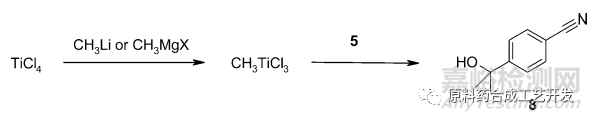
采用TiCl4和甲基鋰原位產(chǎn)生的CH3TiCl3可以完全抑制雜質(zhì)���。
強親核�,弱堿性���。
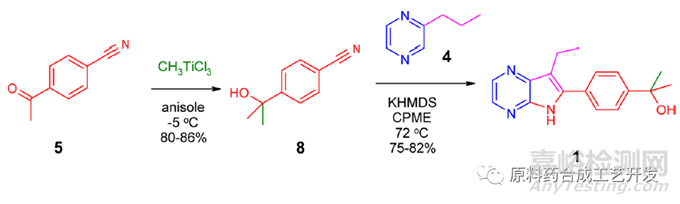
8kg規(guī)模,收率84%
采用甲基格氏試劑和TiCl4原位產(chǎn)生CH3TiCl3方法不行���,反應(yīng)慢。
后續(xù)步驟
化合物8和吡嗪環(huán)4反應(yīng)可得并環(huán)1
實驗操作
制備化合物8
A reactor containing anisole (85 kg) was cooled to −10 to −5 °C. TiCl4 (17 kg, 89.6 mol, 1.5 equiv) was charged over 1 h while maintaining −10 to −5 °C. After stirring at −10 to −5 °C for 15 min, an orange suspension was obtained. A solution of CH3Li in cumene/2-MeTHF (61 kg, 3.2 wt %, 88.9 mol, 1.5 equiv) was charged over 100 min at −10 to −5 °C. The reddish solution was stirred at −10 to −5 °C for 35 min.
A solution of 5 (8.5 kg, 58.6 mol) in anisole (43 kg) was added over 80 min at −10 to −2 °C. The reddish solution was stirred at −5 to −2 °C for 60 min. HPLC analysis of an inprocess sample indicated that the reaction was complete (<0.5%).
The reaction was quenched by the addition of water (4.3 kg) over 30 min at −10 to 0 °C.
參考文獻
Org. Process Res. Dev. 2015, 19, 806−811


 京公網(wǎng)安備11010802046783號