4.26 Cleanroom classification is part of the cleanroom qualification and is a method of assessing the level of air cleanliness against a specification for a cleanroom or clean air equipment by measuring the total particle concentration. Classification activities should be scheduled and performed in order to avoid any impact on process or product quality. For example, initial classification should be performed during simulated operations and reclassification performed during simulated operations or during aseptic process simulation (APS).
潔凈室分級(jí)是潔凈室確認(rèn)的一部分��,是一種根據(jù)潔凈室或潔凈空氣設(shè)備的標(biāo)準(zhǔn)通過測(cè)定總微粒濃度來評(píng)估空氣潔凈度水平的方法����。分級(jí)活動(dòng)的安排和執(zhí)行,應(yīng)避免對(duì)工藝或產(chǎn)品質(zhì)量產(chǎn)生任何影響��。例如�,應(yīng)在模擬操作期間進(jìn)行初步分級(jí),在模擬操作或無菌工藝模擬試驗(yàn)(APS)期間進(jìn)行再分級(jí)��。
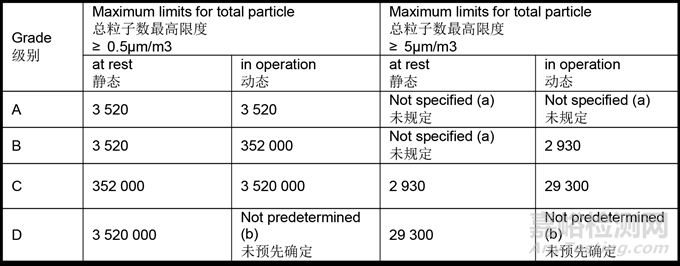
4.27 For cleanroom classification, the total of particles equal to or greater than 0.5 and 5 μm should be measured. This measurement should be performed both at rest and in simulated operations in accordance with the limits specified in Table 1.
對(duì)于潔凈室分級(jí)����,應(yīng)測(cè)定等于或大于0.5μm和5μm的微?�?倲?shù)�。應(yīng)按照表1中規(guī)定的限度,在靜態(tài)和模擬操作中進(jìn)行測(cè)定�。
Table 1: Maximum permitted total particle concentration for classification
表1:各級(jí)別允許的最大總微粒濃度
(a) Classification including 5μm particles may be considered where indicated by the CCS or historical trends.
在CCS或歷史趨勢(shì)中有說明的情況下,可以考慮包括5μm微粒的分級(jí)����。
(b) For grade D, in operation limits are not predetermined. The manufacturer should establish in operation limits based on a risk assessment and routine data where applicable.
對(duì)于D級(jí)區(qū),沒有預(yù)先確定的動(dòng)態(tài)限度����。生產(chǎn)商應(yīng)根據(jù)風(fēng)險(xiǎn)評(píng)估和適用的常規(guī)數(shù)據(jù)建立動(dòng)態(tài)限度�。
9.14 A total particle monitoring program should be established to obtain data for assessing potential contamination risks and to ensure the maintenance of the environment for sterile operations in a qualified state.
應(yīng)建立總粒子數(shù)監(jiān)測(cè)計(jì)劃����,將獲得的數(shù)據(jù)用于評(píng)估潛在污染風(fēng)險(xiǎn),并確保無菌操作環(huán)境維持在經(jīng)確認(rèn)的狀態(tài)�。
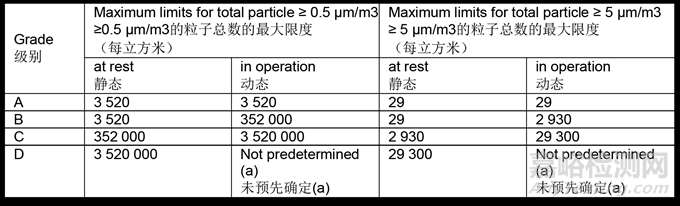
9.15 The limits for environmental monitoring of airborne particle concentration for each graded area are given in Table 5.
各級(jí)別空氣懸浮顆粒濃度環(huán)境監(jiān)測(cè)限度見表5。
Table 5: Maximum permitted total particle concentration for monitoring.
表5:監(jiān)測(cè)最大允許的總粒子濃度��。
(a) For grade D, in operation limits are not predetermined. The manufacturer should establish in operation limits based on a risk assessment and on routine data, where applicable.
對(duì)于D級(jí)��,動(dòng)態(tài)限度未預(yù)先確定�。生產(chǎn)商應(yīng)根據(jù)風(fēng)險(xiǎn)評(píng)估和適用的常規(guī)數(shù)據(jù)建立動(dòng)態(tài)限度。
4.31 The microbial contamination level of the cleanrooms should be determined as part of the cleanroom qualification. The number of sampling locations should be based on a documented risk assessment and the results obtained from room classification, air visualization studies and knowledge of the process and operations to be performed in the area. The maximum limits for microbial contamination during qualification for each grade are given in Table 2. Qualification should include both “at rest” and “in operation” states.
潔凈室的微生物污染水平應(yīng)作為潔凈室確認(rèn)的一部分進(jìn)行確定����。采樣點(diǎn)的數(shù)量應(yīng)基于書面的風(fēng)險(xiǎn)評(píng)估、房間分級(jí)結(jié)果����、氣流可視化研究以及對(duì)該區(qū)域要進(jìn)行的工藝和操作的了解。表2給出了各級(jí)別確認(rèn)過程中的微生物污染最大限度�。確認(rèn)包含“靜態(tài)”和“動(dòng)態(tài)”條件中。
Table 2: Maximum permitted microbial contamination level during qualification
表2:確認(rèn)過程中允許的最大微生物污染水平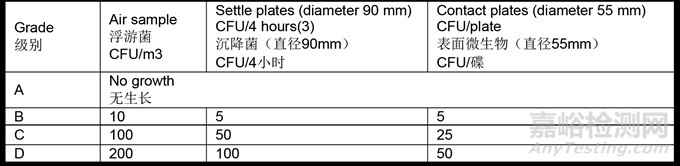
(a) Settle plates should be exposed for the duration of operations and changed as required after a maximum of 4 hours. Exposure time should be based on recovery studies and should not allow desiccation of the media used.
沉降碟應(yīng)在操作期間暴露,并在最多4小時(shí)后按需要更換�。暴露時(shí)間應(yīng)基于回收率研究,并且避免所所用培養(yǎng)基干燥�。
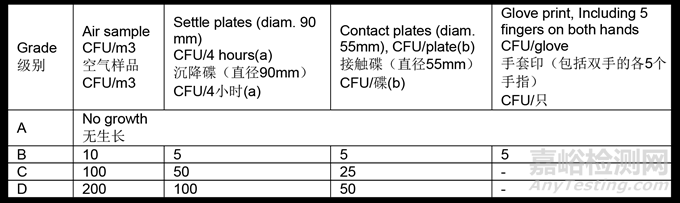
9.30 Action limits for viable particle contamination are shown in Table 6
表列出了活性粒子污染的行動(dòng)限
(a) Settle plates should be exposed in grade A and B areas for the duration of operations (including equipment set-up) and changed as required after a maximum of 4 hours (exposure time should be based on validation including recovery studies and it should not have any negative effect on the suitability of the media used).
沉降碟應(yīng)在操作期間(包括設(shè)備安裝)暴露在A級(jí)和B級(jí)區(qū),并在最多4小時(shí)后按要求更換(暴露時(shí)間應(yīng)基于驗(yàn)證��,包括回收研究����,不應(yīng)對(duì)所用培養(yǎng)基的適用性產(chǎn)生任何負(fù)面影響)。
- For grade C and D areas, exposure time (with a maximum of 4 hours) and frequency should be based on QRM.
-對(duì)于C級(jí)和D級(jí)區(qū)����,暴露時(shí)間(最多4小時(shí))和頻率應(yīng)基于質(zhì)量風(fēng)險(xiǎn)管理(QRM)。
- Individual settle plates may be exposed for less than 4 hours.
-單個(gè)沉降碟的暴露時(shí)間可以少于4小時(shí)�。
(b) Contact plate limits apply to equipment, room and gown surfaces within the grade A and grade B areas. Routine gown monitoring is not normally required for grade C and D areas, depending on their function.
接觸碟限度適用于A級(jí)和B級(jí)區(qū)內(nèi)的設(shè)備��、房間和潔凈服表面��。C級(jí)和D級(jí)區(qū)通常不需要進(jìn)行常規(guī)工作服監(jiān)測(cè)��,具體取決于該區(qū)域的功能�。
(c) It should be noted that for grade A, any growth should result in an investigation.
應(yīng)注意,A級(jí)區(qū)域如有任何長菌情況都應(yīng)進(jìn)行調(diào)查�。

 京公網(wǎng)安備11010802046783號(hào)