為了推動(dòng)非臨床和臨床生物樣品分析數(shù)據(jù)在各監(jiān)管機(jī)構(gòu)間獲得互認(rèn)��,保證分析方法的有效性和可靠性��,以及確保上市許可申請(qǐng)審評(píng)的可靠性���,對(duì)生物樣品分析方法的完善顯得至關(guān)重要。此外��,為了促進(jìn)不同區(qū)域生物樣品分析數(shù)據(jù)集的相互使用�����,對(duì)生物樣品分析方法驗(yàn)證(BMV)的國際協(xié)調(diào)也顯得尤為重要。因此���,自從2019年2月人用藥品技術(shù)要求國際協(xié)調(diào)理事會(huì)(The International Council for Harmonisation of Technical Requirements for Pharmaceuticals for Human Use, ICH)(以下簡稱“ICH”)發(fā)布《生物分析方法驗(yàn)證及樣品分析》M10(BIOANALYTICAL METHOD VALIDATION AND STUDY SAMPLE ANALYSIS, M10��,以下簡稱“ICH M10”)征求意見稿以來��,經(jīng)過業(yè)界多輪討論��,ICH M10最終于2022年5月正式頒布�����。隨后作為ICH監(jiān)管成員的中國國家藥品監(jiān)督管理局(National Medical Products Administration, NMPA)(以下簡稱“NMPA”)也為了推動(dòng)ICH三級(jí)指導(dǎo)原則在中國的平穩(wěn)落地和實(shí)施���,發(fā)布了關(guān)于公開征求ICH《M10:生物分析方法驗(yàn)證及樣品分析》指導(dǎo)原則實(shí)施建議和中文版的通知;在2022年11月美國食品藥品監(jiān)督管理局(U.S Food and Drug Administration, FDA)(以下簡稱“FDA”)作為ICH的創(chuàng)始監(jiān)管成員�����,也發(fā)文采納M10的建議并發(fā)布行業(yè)指南��。在2022年11月16日��,歐洲藥品管理局(European Medicines Agency, EMA)(以下簡稱“EMA”)也作為ICH成員發(fā)布了對(duì)應(yīng)的Q&A���,本文件已在2023年1月21日生效��。同時(shí)��,NMPA在2023年1月29日也發(fā)布了2023年第16號(hào)公告��,自2023年7月29日起的研究均適用《M10:生物分析方法驗(yàn)證及樣品分析》國際人用藥品協(xié)調(diào)會(huì)指導(dǎo)原則��。
首先�����,我們來看一下ICH M10正式版的更新內(nèi)容�����。其中��,重點(diǎn)更新了以下幾個(gè)方面:
對(duì)于生物樣品分析方法的定義和范圍進(jìn)行了明確���。ICH M10明確了生物樣品分析方法的定義��,包括了用于測(cè)量藥物和其代謝產(chǎn)物在生物樣品中的濃度的所有分析方法。
對(duì)于方法驗(yàn)證的步驟進(jìn)行了詳細(xì)的描述���。ICH M10指出�����,方法驗(yàn)證應(yīng)該包括方法設(shè)計(jì)���、方法優(yōu)化���、方法驗(yàn)證、方法轉(zhuǎn)移以及方法的例行監(jiān)控等步驟�����。
對(duì)于方法驗(yàn)證的參數(shù)進(jìn)行了明確���。ICH M10明確了方法驗(yàn)證的參數(shù)�����,包括選擇性���、靈敏度、精密度、準(zhǔn)確度��、回收率���、穩(wěn)定性等�����。
對(duì)于方法驗(yàn)證的接受標(biāo)準(zhǔn)進(jìn)行了明確��。ICH M10明確了每個(gè)參數(shù)的接受標(biāo)準(zhǔn)�����,以及在何種情況下需要重新驗(yàn)證��。
接下來�����,我們?cè)賮砜匆幌翹MPA 2020版《中國藥典》9012部分指導(dǎo)原則(以下簡稱“NMPA 2020版”)和FDA 2018年的(Bioanalytical Method Validation, BMV)(以下簡稱“FDA 2018版BMV”)指導(dǎo)原則的考察項(xiàng)要求�����。
NMPA 2020版對(duì)于生物樣品分析方法的要求主要包括了方法的選擇��、優(yōu)化�����、驗(yàn)證和例行監(jiān)控等環(huán)節(jié)��。其中���,對(duì)于方法驗(yàn)證的參數(shù),NMPA 2020版明確了選擇性�����、靈敏度�����、精密度��、準(zhǔn)確度�����、回收率�����、穩(wěn)定性等參數(shù)的要求,但是對(duì)于接受標(biāo)準(zhǔn)的要求并沒有明確��。
FDA 2018版BMV指導(dǎo)原則對(duì)于生物樣品分析方法的要求與NMPA 2020版相似�����,但是在方法驗(yàn)證的參數(shù)方面�����,F(xiàn)DA 2018版BMV指導(dǎo)原則更加詳細(xì)��,包括了線性范圍���、最低定量限度���、精密度、準(zhǔn)確度�����、選擇性�����、穩(wěn)定性、回收率等參數(shù)��,并且對(duì)于每個(gè)參數(shù)的接受標(biāo)準(zhǔn)進(jìn)行了明確��。
總的來說�����,ICH M10正式版與NMPA 2020版和FDA 2018版BMV指導(dǎo)原則在生物樣品分析方法的要求方面有很多相似之處���,但是在方法驗(yàn)證的參數(shù)和接受標(biāo)準(zhǔn)方面,ICH M10正式版更加詳細(xì)和明確�����。本文會(huì)針對(duì)具體考察項(xiàng)要求之間的差異進(jìn)行解析���,更加深入地理解ICH M10生物分析方法驗(yàn)證及樣品分析指導(dǎo)原則中的內(nèi)容��。
指導(dǎo)原則和法規(guī)指南(NMPA/M10/FDA)的差異化解析
替代基質(zhì)
針對(duì)2.2.1完整驗(yàn)證部分��,ICH M10“The choice of surrogate matrix should be scientifically justified. Matrix differences within species (e.g., age, ethnicity, gender) are generally not considered different when validating a method.”��。值得注意的是同一物種不同種族如外國人與中國人基質(zhì)間的差異性比對(duì)實(shí)驗(yàn)無需再考察���。
選擇性
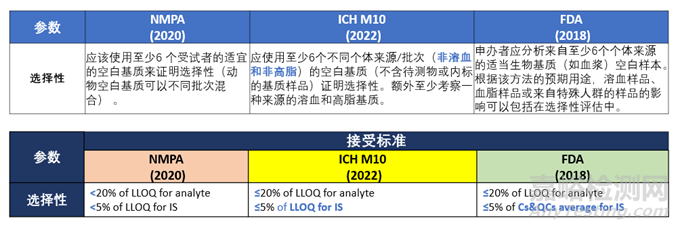
針對(duì)3.2.1選擇性部分��,ICH M10“Selectivity should be evaluated using blank samples (matrix samples processed without addition of an analyte or IS) obtained from at least 6 individual sources/lots (non-haemolysed and non-lipaemic). For the investigation of selectivity in lipaemic matrices at least one source of matrix should be used. If the drug impacts lipid metabolism or if the intended patient population is hyperlipidaemic, the use of spiked samples is discouraged. This evaluation is not necessary for nonclinical studies unless the drug impacts lipid metabolism or is administered in a particular animal strain that is hyperlipidaemic.For the investigation of selectivity in haemolysed matrices at least one source of matrix should be used. Haemolysed matrices should be obtained by spiking matrix with haemolysed whole blood (at least 2% V/V) to generate a visibly detectable haemolysed sample.”��。而NMPA 2020版中的選擇性要求��,“應(yīng)該使用至少6個(gè)受試者的適宜的空白基質(zhì)來證明選擇性”���。FDA 2018版BMV的選擇性要求,“Depending on the intended use of the assay, the impact of hemolyzed samples, lipemic samples, or samples from special populations can be included in the selectivity assessment. The sponsor should analyze blank samples of the appropriate biological matrix (e.g. plasma) from at least six (for CCs) or ten (for LBAs) individual sources”�����。
此部分中ICH M10明確要求至少6個(gè)不同個(gè)體來源的空白基質(zhì)中是不包含溶血與高脂基質(zhì)的��,而需要額外考察其選擇性���,且對(duì)于溶血和高脂基質(zhì)有明確要求���,對(duì)應(yīng)的接受標(biāo)準(zhǔn)存在細(xì)微差別,詳見下表:
基質(zhì)效應(yīng)
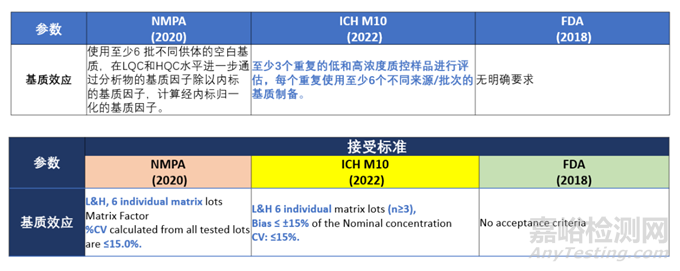
針對(duì)3.2.3基質(zhì)效應(yīng)部分��,ICH M10“The matrix effect should be evaluated by analysing at least 3 replicates of low and high QCs, each prepared using matrix from at least 6 different sources/lots. The matrix effect should also be evaluated in relevant patient populations or special populations (e.g., hepatically impaired or renally impaired) when available. An additional evaluation of the matrix effect is recommended using haemolysed or lipaemic matrix samples during method validation on a case-by-case basis, especially when these conditions are expected to occur within the study.”。而NMPA 2020版中的基質(zhì)效應(yīng)要求���,“使用至少6批來自不同供體的空白基質(zhì)��,通過計(jì)算基質(zhì)存在下的峰面積(由空白基質(zhì)提取后加入分析物和內(nèi)標(biāo)測(cè)得)��,與不含基質(zhì)的相應(yīng)峰面積(分析物和內(nèi)標(biāo)的純?nèi)芤海┍戎?����,?jì)算每一分析物和內(nèi)標(biāo)的基質(zhì)因子,計(jì)算經(jīng)內(nèi)標(biāo)歸一化的基質(zhì)因子”���。FDA 2018版BMV中無基質(zhì)效應(yīng)的要求�����。
此部分中ICH M10的評(píng)估方式與接受標(biāo)準(zhǔn)變動(dòng)最大�����,完全改變了常規(guī)基質(zhì)效應(yīng)中運(yùn)用基質(zhì)因子進(jìn)行評(píng)估的做法��,因此在進(jìn)行基質(zhì)效應(yīng)的評(píng)估時(shí)應(yīng)注意前處理操作方式與接受標(biāo)準(zhǔn)的變化��,但不論是ICH M10還是NMPA 2020版都要求除正?��;|(zhì)外��,還應(yīng)關(guān)注其他樣品的基質(zhì)效應(yīng)���,例如溶血或高脂,具體操作與接受標(biāo)準(zhǔn)詳見下表:
穩(wěn)定性
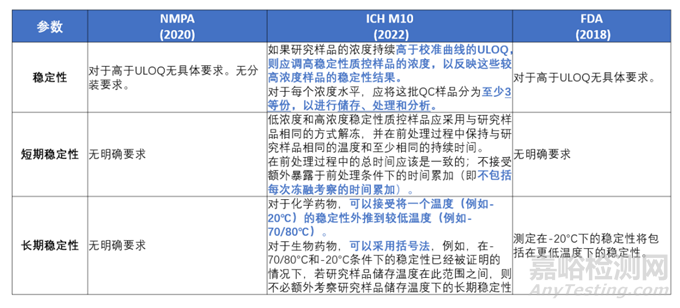
針對(duì)3.2.8穩(wěn)定性部分��,ICH M10“Stability of the analyte in the matrix is evaluated using low and high concentration QCs. Aliquots of the low and high QCs are analysed at time zero and after the applied storage conditions that are to be evaluated. One bulk QC should be prepared at each concentration level. For each concentration tested, the bulk sample should be divided into a minimum of 3 aliquots that will be stored, stressed and analysed.If the concentrations of the study samples are consistently higher than the ULOQ of the calibration range, the concentration of the high QC should be adjusted to reflect these higher concentrations.”而NMPA 2020版和FDA 2018版BMV中無高于ULOQ的穩(wěn)定性要求��,也無分裝�����、儲(chǔ)存���、處理和分析穩(wěn)定性樣品的細(xì)節(jié)要求��。因此在進(jìn)行穩(wěn)定性樣品的準(zhǔn)備及其考察時(shí)�����,應(yīng)注意上述細(xì)節(jié)來匹配現(xiàn)行法規(guī)的要求���。
對(duì)于短期穩(wěn)定性�����,ICH M10要求���,“The total time on the bench top should be concurrent; it is not acceptable to use additive exposure to bench top conditions (i.e., time from each freeze-thaw evaluation should not be added up).”。而NMPA 2020版和FDA 2018版BMV中無短期穩(wěn)定性總時(shí)間計(jì)算細(xì)則�����。
對(duì)于長期穩(wěn)定性���,ICH M10明確表明��,“For chemical drugs, the stability at one temperature (e.g., -20°C) to can be extrapolated to lower temperatures (e.g., -70/-80°C). For biological drugs, a bracketing approach can be applied, e.g., in the case that the stability has been demonstrated at -70/-80°C and at -20°C, then it is not necessary to investigate the stability at temperatures in between those two points at which study samples will be stored.”。這樣在實(shí)操中��,譬如有時(shí)由于冰箱長時(shí)間不開門��,研究樣品在保存過程中出現(xiàn)低于冰箱驗(yàn)證的溫度范圍時(shí)�����,即可評(píng)估無影響。
FDA 2018版BMV中也有類似描述���,如“Determination of stability at minus 20ºC would cover stability at colder temperatures.”���,而NMPA 2020版中并無此要求。針對(duì)上述內(nèi)容的比較詳見下表內(nèi)容�����,
進(jìn)樣重現(xiàn)性
針對(duì)3.2.9進(jìn)樣重現(xiàn)性部分���,ICH M10“Reinjection reproducibility is assessed by reinjecting a run that is comprised of calibration standards and a minimum of 5 replicates of the low, middle and high QCs after storage. The precision and accuracy of the reinjected QCs establish the viability of the processed samples.”�����。而NMPA 2020版和FDA 2018版BMV中無單獨(dú)的部分描述而是在穩(wěn)定性部分要求的在低和高濃度質(zhì)控樣品濃度水平進(jìn)行考察�����,具體的考察詳見下表:
已測(cè)樣品再分析(ISR)
針對(duì)5已測(cè)樣品再分析(ISR)部分��,ICH M10“ISR should be performed within the stability window of the analyte, but not on the same day as the original analysis. If the overall ISR results fail the acceptance criteria, an investigation should be conducted and the causes remediated. There should be an SOP that directs how investigations are triggered and conducted. If an investigation does not identify the cause of the failure, the potential impact of an ISR failure on study validity should also be provided in the Bioanalytical Report. If ISR meets the acceptance criteria yet shows large or systemic differences between results for multiple samples, this may indicate analytical issues and it is advisable to investigate this further. Examples of trends that are of concern may include: All ISR samples from one subject fail. All ISR samples from one run fail. All aspects of ISR evaluations should be documented to allow reconstruction of the study and any investigations. Individual samples that are quite different from the original value (e.g., > 50%, “flyers”) should not trigger reanalysis of the original sample and do not need to be investigated. ISR sample data should not replace the original study sample data”���,強(qiáng)調(diào)了1)ISR需要在待測(cè)物穩(wěn)定性窗口內(nèi)進(jìn)行�����。2)如果ISR結(jié)果失敗通過調(diào)查后不能確定其失敗的原因��,則應(yīng)在分析報(bào)告中提供ISR失敗對(duì)試驗(yàn)有效性的影響評(píng)估�����。3)如果ISR滿足接受標(biāo)準(zhǔn)��,但在多個(gè)樣品的結(jié)果中顯示較大的或系統(tǒng)性誤差��,這可能表明分析存在問題��,建議繼續(xù)開展調(diào)查���。而對(duì)于個(gè)別偏差很大的單個(gè)樣品不必進(jìn)行調(diào)查。而NMPA 2020版和FDA 2018版BMV中并無上述要求���。
ICH M10在ISR部分有更加細(xì)致的要求和實(shí)操性更好的操作指導(dǎo),如調(diào)查失敗時(shí)對(duì)于結(jié)果的評(píng)估與匯報(bào)
交叉驗(yàn)證
針對(duì)6.2交叉驗(yàn)證部分�����,ICH M10“Cross validation should be performed in advance of study samples being analysed, if possible.Cross validation should be assessed by measuring the same set of QCs (low, medium and high) at least in triplicate and study samples (if available) that span the study sample concentration range (n≥30) with both methods, or in both laboratories.”而對(duì)于NMPA 2020版和FDA 2018版BMV中有對(duì)于交叉驗(yàn)證的內(nèi)容和接受標(biāo)準(zhǔn),但是未對(duì)需要完成的樣品數(shù)量與QC的濃度水平進(jìn)行規(guī)定和要求��。
對(duì)于接受標(biāo)準(zhǔn)���,ICH M10無明確規(guī)定���,“Bias can be assessed by Bland-Altman plots or Deming regression. Other methods appropriate for assessing agreement between two methods (e.g., concordance correlation coefficient) may be used too. Alternatively, the concentration vs. time curves for study samples could be plotted for samples analysed by each method to assess bias.”。而NMPA 2020版中關(guān)于交叉驗(yàn)證則有明確規(guī)定了接受標(biāo)準(zhǔn)���,“對(duì)于質(zhì)控樣品�����,不同方法獲得的平均準(zhǔn)確度應(yīng)在±15 %范圍內(nèi)���,如果放寬,應(yīng)該說明理由���。對(duì)于試驗(yàn)樣品�����,至少67 % 樣品測(cè)得的兩組數(shù)值差異應(yīng)在兩者均值的±20 %范圍內(nèi)�����。”FDA 2018版BMV要求SOP或者驗(yàn)證方案中定義接受標(biāo)準(zhǔn)��,“An SOP or validation plan should define the criteria a priori.”���。
待測(cè)物同為內(nèi)源性物質(zhì)的分析方法
針對(duì)7.1待測(cè)物同為內(nèi)源性物質(zhì)分析方法的準(zhǔn)確度和精密度部分�����,ICH M10“Accuracy and precision should meet criteria specified in Sections 3 and 4 for chromatography and LBAs, respectively. The concentration of the endogenous molecule in the blank matrix may be determined and subtracted from the total concentrations observed in the spiked samples. Only the precision can be determined from the analysis of each unspiked/endogenous QC.”建議使用以下公式計(jì)算準(zhǔn)確度���,
對(duì)于穩(wěn)定性來說,除了需要考察實(shí)際生物基質(zhì)中的真實(shí)待測(cè)物之外���,還應(yīng)證明替代基質(zhì)中待測(cè)物的穩(wěn)定性���,這部分在實(shí)操中也尤為重要。
結(jié)語
綜上所述��,我們?cè)敿?xì)剖析了ICH M10的相關(guān)規(guī)定�����,通過差異化分析的方式了解及明確生物分析檢測(cè)過程中的具體操作及實(shí)施���,且隨著ICH M10的生效���,對(duì)于一些特殊情況的處理方式在實(shí)操過程中也變得更加容易理解與執(zhí)行?��?偠灾?��,ICH M10作為一個(gè)統(tǒng)一的行業(yè)標(biāo)準(zhǔn),整合了各個(gè)監(jiān)管機(jī)構(gòu)的生物分析檢測(cè)法規(guī)指南��,使得法規(guī)依從性下的生物分析檢測(cè)工作更易執(zhí)行��。
參考文獻(xiàn)
[1] US FDA Guidance for Industry, Bioanalytical Method Validation, May 2018
[2]中國藥典2020年版��,生物樣品定量分析方法驗(yàn)證指導(dǎo)原則��,2020年12月1日生效
[3] ICH harmonized Guideline, Bioanalytical Method Validation and Study Sample Analysis (M10), effective 24 May 2022



 京公網(wǎng)安備11010802046783號(hào)