在制藥實驗室的色譜分析工作中�����,手動積分是一項需要謹慎對待的操作�����,稍有不慎就可能影響數(shù)據(jù)的完整性�����,進而對藥品質(zhì)量把控和合規(guī)性造成挑戰(zhàn)��。本文結(jié)合 WHO 良好色譜規(guī)范與 PDA TR80 指南�����,探討手動積分的合規(guī)要求��、潛在風險及管理要點���,為實驗室人員提供操作參考。
一�����、手動積分的定義與適用場景
手動積分是指分析師通過色譜軟件手動調(diào)整基線等參數(shù)�����,對色譜峰的高度或面積進行積分的過程��。根據(jù) PDA TR80 定義�����,這一操作可能引入人為干預風險,因此僅允許在特殊情況下使用���,例如:
•復雜樣品基質(zhì)干擾:當樣品中成分復雜�����,自動積分無法準確區(qū)分目標峰與干擾峰時(如多組分共洗脫或基線漂移嚴重)�����。
•儀器局限性:老舊色譜系統(tǒng)或軟件自動積分功能不完善��,無法滿足分析方法要求�����。
•方法驗證明確允許:經(jīng)預先驗證的標準操作程序(SOP)中明確規(guī)定可手動積分的特定情形(如 USP<621> 允許在系統(tǒng)適用性失敗后謹慎調(diào)整)��。
二�����、手動積分的合規(guī)性要求
(一)權(quán)限與審批流程
•授權(quán)控制:手動積分權(quán)限需嚴格限定于經(jīng)培訓的資深分析師,并通過實驗室管理系統(tǒng)(如 LIMS)進行用戶權(quán)限分配�����,禁止普通操作人員擅自操作���。
•審批記錄:每次手動積分需提前提交申請��,說明原因(如“樣品基質(zhì)干擾導致自動積分偏差”),經(jīng)技術(shù)主管或質(zhì)量部門(QA)書面批準后方可執(zhí)行��。
(二)操作記錄與追溯
•元數(shù)據(jù)留存:手動積分過程需完整記錄以下信息并關(guān)聯(lián)至原始數(shù)據(jù)文件:
–操作人員 ID、操作時間�����;–積分參數(shù)修改細節(jié)(如基線調(diào)整方式�����、峰起止點變化)��;
–審批人姓名及審批時間。
•審計追蹤:色譜軟件需啟用審計追蹤功能,自動記錄手動積分的“前 / 后” 數(shù)據(jù)對比(如原始自動積分結(jié)果與手動調(diào)整后結(jié)果),確保數(shù)據(jù)可追溯���。例如�����,F(xiàn)DA 要求審計追蹤需包含 “誰、何時��、為何” 修改數(shù)據(jù)的完整軌跡��。
(三)數(shù)據(jù)記錄與報告
•書面說明:分析報告中需專節(jié)說明手動積分的原因���、方法及合理性論證��,附原始色譜圖(標注自動與手動積分差異)。
•電子簽名:若采用電子報告,需按照 21 CFR Part 11 要求進行電子簽名,確保數(shù)據(jù)不可篡改���。
三���、風險與防控措施
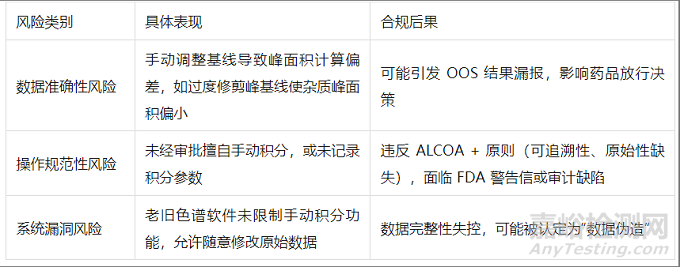
(一)主要風險類型
(二)防控措施
•技術(shù)控制:
–升級色譜系統(tǒng)軟件��,設(shè)置“手動積分僅允許在鎖定原始數(shù)據(jù)副本上操作” 的功能��;
–采用標準化積分模板��,限定可調(diào)整參數(shù)范圍(如峰寬���、閾值上下限)。��、
•流程優(yōu)化:
–建立“自動積分優(yōu)先” 原則,將手動積分作為最后手段���;
–定期開展積分一致性評估��,對比不同分析師手動積分結(jié)果的差異。
•培訓與監(jiān)督:
–每年開展手動積分專項培訓�����,結(jié)合案例分析違規(guī)后果;
–QA 部門每季度抽查手動積分記錄��,重點核查審批流程與數(shù)據(jù)追溯性。
四�����、典型違規(guī)案例與教訓
峰積分參數(shù)混亂:同一序列對照品與樣品積分參數(shù)不一
Specifically, laboratory tests conducted to determine multiple batches of (b)(4) API to the written specifications are deficient Deficiencies were observed in the processing methods and integration of peaks during analysis of impurities and residual solvents in various batches of (b)(4) USP. The QC Lab used different processing methods with inconsistent peak integration parameters to integrate peaks of the standards, and different lots of the product in the same HPLC/GC run, For example:
具體而言��,為確定多批次 (b)(4) 原料藥是否符合書面質(zhì)量標準而進行的實驗室檢測存在缺陷���。在對多批次美國藥典(USP)標準下的 (b)(4) 原料藥中的雜質(zhì)和殘留溶劑進行分析時���,發(fā)現(xiàn)了在處理方法和峰積分方面存在缺陷。質(zhì)量控制實驗室在同一高效液相色譜(HPLC)/氣相色譜(GC)運行過程中���,使用了不同的處理方法以及不一致的峰積分參數(shù)�����,對標準品的峰以及不同批次的產(chǎn)品進行積分��。例如:
A: On 5/7/2020, the Qc Lab tested two batches (# (b)(4) of (b)(4) for Impurity Profile. The lab used three different processing methods (method ID: 4159,4206, and 4239) to integrate the peaks of standards, Lot (b)(4) and Lot (b)(4) respectively. Peak integration parameters used for a US batch (b)(4) (as per processing method ID; 4206) are as below:
2020年5月7日�����,質(zhì)量控制實驗室對兩個批次(用于雜質(zhì)概況分析的某產(chǎn)品的 (b)(4) 批號)進行了檢測���。實驗室分別使用了三種不同的處理方法(方法編號:4159���、4206 和 4239),對標準品���、 (b)(4) 批號和 (b)(4) 批號的峰進行積分�����。用于美國某產(chǎn)品 (b)(4) 批號(根據(jù)處理方法編號 4206)的峰積分參數(shù)如下:
Under these integration parameters, any impurity peak/s with peak area of less than (b)(4) will not be integrated that elute before (b)(4) Similarly. any unknown impurity peak/s with peak height of less than (b)(4) will not be integrated after (b)(4) and will not be accounted for towards the maximum unknown impurity specifications. The peak height for the largest known impurity (b)(4) and largest unknown impurity (b)(4) was observed to be (b)(4) and (b)(4) respectively. [he sample run tire for the impurities analysis is (b)(4) .
在這些積分參數(shù)下���,任何在 (b)(4) 峰之前洗脫且峰面積小于 (b)(4) 的雜質(zhì)峰將不會被積分。同樣地���,任何在 (b)(4) 峰之后洗脫且峰高小于 (b)(4) 的未知雜質(zhì)峰也不會被積分���,并且在計算最大未知雜質(zhì)規(guī)格時不會將其納入考量。已觀察到最大已知雜質(zhì)(b)(4)和最大未知雜質(zhì)(b)(4)的峰高分別為 (b)(4) 和 (b)(4) ��。雜質(zhì)分析的樣品運行時間為 (b)(4) 。
B: On 5/8/2020, the QC Lab tested two US batches (# (b)(4) of (b)(4) for residual solvent analysis by GC. The lab used three different processing methods (method ID: 3023, 3078 and 3090) to integrate the peaks of standards, Lot (b)(4) respectively. Peak integration parameters selected for a US batch (b)(4) ( as per processing method ID: 3078) are as below:
2020年5月8日�����,質(zhì)量控制實驗室對兩個美國批次(某產(chǎn)品的 (b)(4) 批號)進行了氣相色譜(GC)檢測�����,以分析殘留溶劑情況���。實驗室分別使用了三種不同的處理方法(方法編號:3023、3078 和 3090)�����,對標準品�����、 (b)(4) 批號的峰進行積分��。針對美國某產(chǎn)品 (b)(4) 批號(根據(jù)處理方法編號3078)所選擇的峰積分參數(shù)如下:
Under these processing parameters, any potential unknown peak/s with peak area set loss than a specific value for specific time frame will not be integrated. The sample run time for the Impurities analysis is about (b)(4)
在這些處理參數(shù)下�����,在特定時間段內(nèi),任何峰面積設(shè)定值小于特定數(shù)值的潛在未知峰都不會進行積分�����。雜質(zhì)分析的樣品運行時間約為 (b)(4) ���。
The firm shipped xxx batches (manufactured in 2020; and expiring in (b)(4) of (b)(4) for the US market.
貴司向美國市場銷售了某數(shù)量批次的產(chǎn)品(生產(chǎn)日期為2020年��,有效期為 (b)(4) )���。
手動積分管理不足:電泳圖手動積分前未優(yōu)化處理方法
The (b)(4) Standard Test Procedure requires electropherograms generated during the purity by NR CE- SDS be integrated first using a standard processing method, If this does not provide appropriate integration, the procedure allows modifications to optimize the processing method by making changes one at a time. Only if the method cannot be optimized, the procedure allows analysts to request to use manual integration. Review of electropherograms found no meaningful attempt was being made to optimize processing methods before manual integration. A NR CE-SDS analyst stated manual integration is being used (b)(4) % of the time.
(b)(4) 標準測試程序要求在 NR CE- SDS 純度測試過程中生成的電泳圖首先使用標準處理方法進行積分。如果不能進行適當?shù)恼?�,程序允許通過逐次修改來優(yōu)化處理方法�����,以優(yōu)化處理方法��。只有在無法優(yōu)化處理方法的情況下�����,程序才允許分析人員要求使用手動積分。對電泳圖的審查發(fā)現(xiàn)��,在手動積分之前�����,沒有對處理方法進行有意義的優(yōu)化�����。一位 NR CE-SDS 分析員稱�����,有 (b)(4) % 的時間使用手動積分���。
手動積分規(guī)程空白:色譜手動積分操作審查程序缺失
Manual integration of chromatograms is permitted. Procedures describing when manual integration can be performed, how it is to be performed, and how it will be reviewed have not been established.
允許對色譜進行手動積分。還沒有制定說明何時可以進行手動積分�����、如何進行手動積分以及如何對手動積分進行審查的程序��。

 京公網(wǎng)安備11010802046783號